

Auckland’s growth story has always been driven by infrastructure. Where transport investment leads, housing demand follows and long-term capital growth tends to reward those who act early.
Right now, no corridor in the city reflects that pattern more clearly than Auranga, Drury and Karaka.
Once viewed as semi-rural fringe suburbs, this southern growth belt is rapidly transforming into a fully connected urban centre supported by major rail upgrades, motorway improvements, large-scale retail investment, employment hubs, and a clear population growth mandate from central and local government.
For both first-home buyers and property investors, this isn’t speculation. It’s a textbook example of how cities expand and where opportunity is created well before the final pieces are in place.
From “Dreary Drury” to a City in the Making
For decades, Drury was little more than a name on a motorway sign – a rural village sitting quietly 35 – 40km south of Auckland’s CBD.
That perception no longer holds.
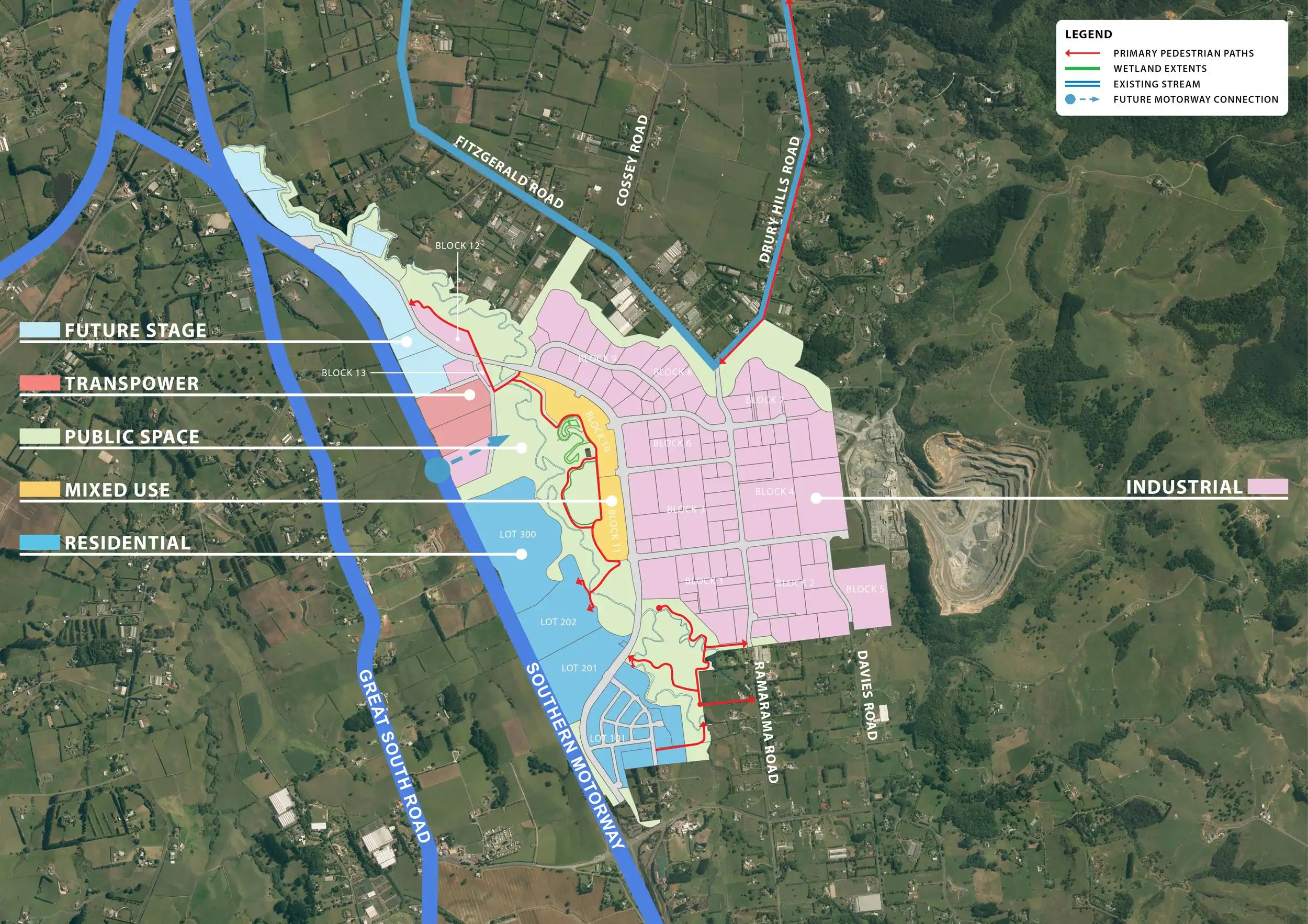
Today, earthworks, road realignments and master-planned developments signal a structural shift underway. Auckland Council’s Southern Rural Strategy forecasts more than 60,000 new residents in Drury alone over the next 20 years, with over 100,000 people expected across the wider southern corridor within 30 years.
What makes this growth particularly significant is where Drury sits – at the heart of the Golden Triangle linking Auckland, Hamilton and Tauranga. This strategic position is driving not just residential demand, but major commercial, logistics and retail investment – all of which feeds back into housing value and rental demand.
Infrastructure First: Why This Growth Is Different
What sets the Auranga–Drury–Karaka corridor apart from many past growth areas is timing. This time, infrastructure is being delivered ahead of population density, not years after it.
Rail Connectivity by 2026–27
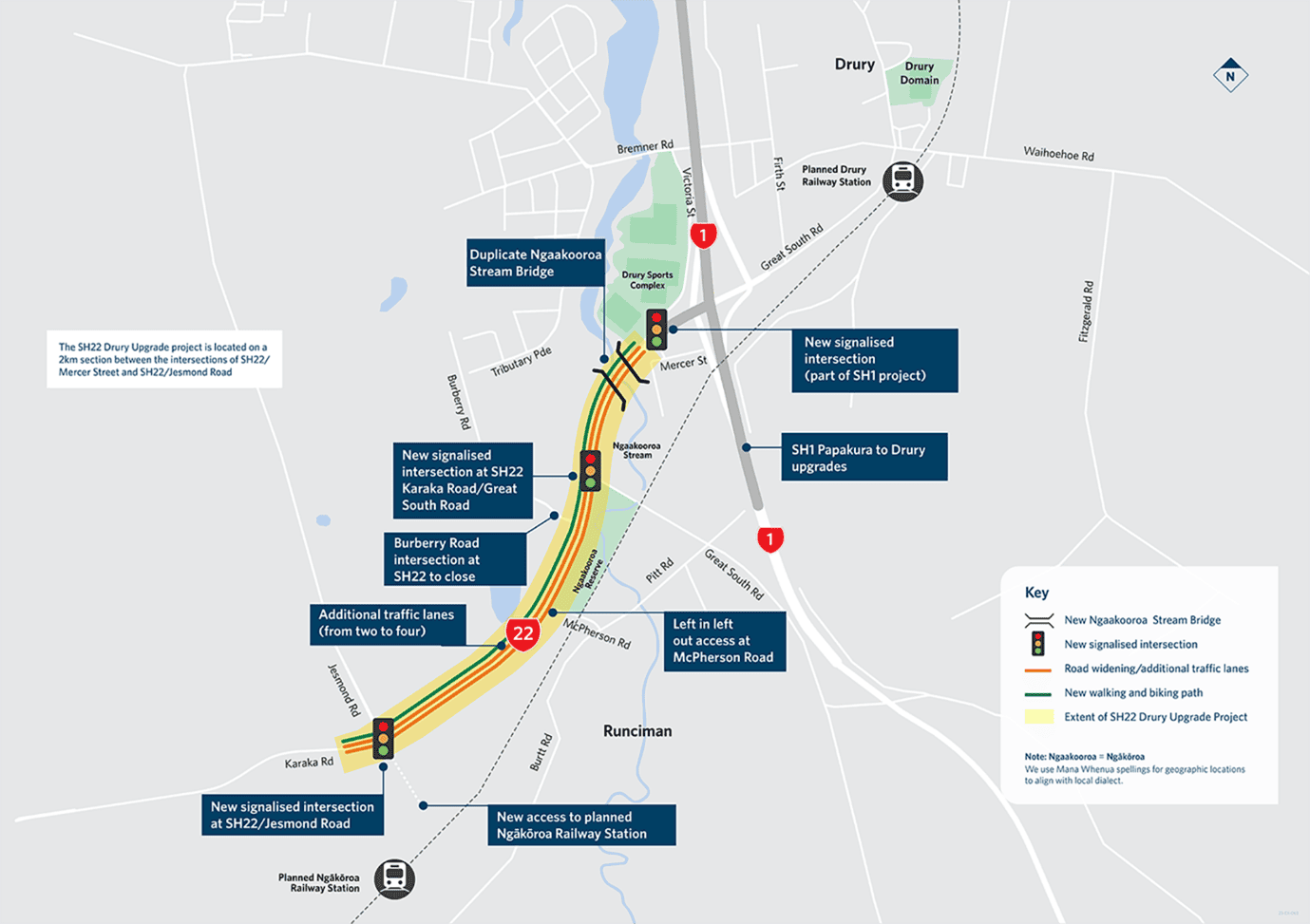
Three new rail stations – Drury Central, Ngākōroa (Drury West), and Paerātā are under construction, supported by full electrification from Papakura to Pukekohe.
Once operational, residents will have direct rail access into Auckland’s CBD, backed by bus interchanges, park-and-ride facilities, and active transport links. Longer platforms and future track capacity ensure the network is designed for long-term scale, not short-term fixes.
For property buyers, this matters. Rail connectivity consistently underpins stronger demand, better resilience during market cycles, and long-term value growth.
Motorway and Road Upgrades
Significant investment is also underway on State Highway 22 and surrounding road networks, including lane widening, new bridges, safer intersections, and improved access to both residential developments and new rail stations.
Put simply: better access reduces friction. Reduced friction increases liveability. Liveability supports demand.
Big-Box Retail and Employment: Demand Drivers You Can’t Ignore
Residential growth alone doesn’t create sustainable property markets. Jobs, services and retail do.
That’s why the confirmation of Auckland’s second Costco in Drury is such a critical signal. Costco’s site selection criteria are rigorous – population growth, transport access, household spending capacity, and long-term viability all factor heavily.
Costco is not alone.
Drury is attracting hundreds of millions of dollars in big-box retail, logistics, automated warehousing, and data centre investment. Major national retailers are consolidating distribution into large, purpose-built facilities in the area, drawn by scale, connectivity, and lower land costs than central Auckland.
For investors, this translates into:
- Stronger local employment
- Reduced reliance on long commutes
- Higher tenant demand
- More resilient rental yields over time
Auranga: The Blueprint for Modern Southern Living
Auranga, a large-scale master-planned community, has already demonstrated what this part of Auckland is becoming.
While still maturing, Auranga shows how density, walkability, green spaces and long-term planning can coexist. As retail, community facilities and transport links come online over the next few years, the early stages of Auranga are expected to benefit significantly from that maturation curve.
This same pattern is now extending further south into Drury and Karaka where newer developments are emerging with better pricing entry points and long-term upside.
Why Investors Are Looking Ahead to 2026 – Not Just Today
Property cycles reward those who buy before convenience is fully realised.
By 2026:
- Rail stations will be operational or close to completion
- Major road upgrades will be well advanced
- Retail and employment hubs will be established
- Population growth will be visible, not theoretical
At the same time, the interest-rate environment is shifting. While the Official Cash Rate has come down, banks have recently begun lifting some longer-term fixed mortgage rates, reflecting wholesale funding costs and expectations of future stability rather than further sharp declines.
This signals a market moving out of volatility and into a more stable phase.
Historically, that transition period has favoured buyers who act decisively rather than waiting for “perfect” conditions.
As the saying goes: the best time to buy was yesterday – the next best time is today.
Two Developments to Watch Closely: Burberry Heights & Watermere Residences
Within this growth corridor, Goodform Properties has positioned two developments that cater to different buyer profiles while both benefiting from the same underlying fundamentals.
Burberry Heights – Premium, Family-Focused Living
Burberry Heights is a more established, premium offering designed for owner-occupiers and multi-generational families. With move-in-ready homes and strong liveability appeal, the development is almost completely sold out – a clear signal of demand for quality housing in this location.
For buyers seeking long-term family homes with capital protection, Burberry Heights reflects what the southern corridor is already capable of delivering.
Watermere Residences – Accessible Entry into a High-Growth Location
Watermere Residences represents the next phase of opportunity.
With 12 brand-new duplex homes priced from $799,000, Watermere is deliberately positioned for more budget-conscious buyers, first-home purchasers, and investors looking to secure a foothold in the area before full infrastructure completion.
Groundworks are already underway, with completion expected in Q4 2026 aligning closely with major transport milestones.
For many buyers, this is the sweet spot: buying into tomorrow’s fully realised suburb at today’s pricing.
A Rare Alignment of Timing, Infrastructure and Affordability
Opportunities like this don’t emerge often.
The Auranga–Drury–Karaka corridor offers a rare convergence of:
- Government-backed infrastructure investment
- Confirmed population growth
- Major retail and employment commitments
- Improved transport connectivity
- Relative affordability compared to central Auckland
For first-home buyers, it provides a pathway into home ownership without sacrificing long-term upside.
For investors, it presents scale, demand, and fundamentals that support sustainable returns.
Looking to Invest in Auckland’s Next Growth Hotspot?
Burberry Heights
Multi-generational homes from $850,000
Move-in ready | Limited availability remaining
Watermere Residences
12 brand-new duplex homes from $799,000
Construction underway | Completion Q4 2026
For more information, contact Nicolas Ching
📞 021 184 7777
✉️ nicolas@gfp.co.nz