

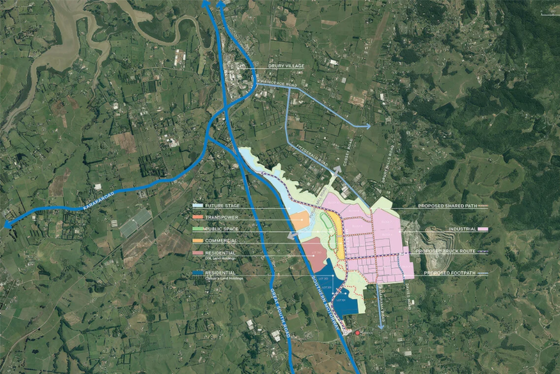
If you’ve driven through Karaka–Drury lately, you might wonder: “Why buy here now, when there’s not much happening yet?”
That’s a fair question – and the honest answer is this: while today the region still feels semi-rural, the next 10 – 15 years are set to bring major transformation. New train stations, motorway upgrades, and an entirely new town centre are planned. Those projects could underpin strong property growth in the decades ahead.
Some commentators point to 8%+ annual growth forecasts for the region. That’s exciting, but it’s important to remember: this is only a forecast, not a certainty. It’s based on the assumption that Auckland’s historical 5–6% annual growth rate continues and that Karaka–Drury sees an additional uplift from the large-scale infrastructure and development planned here.
A city-sized expansion at Auckland’s edge
Auckland Council’s Drury–Opāheke Structure Plan shows the scale: around 22,000 new homes, ~12,000 jobs and ~60,000 new residents are expected over the next 30 years – effectively adding a new city the size of Rotorua or Napier at Auckland’s southern edge.
Supporting this growth are multi-billion-dollar infrastructure projects:
- Three new southern rail stations (Drury, Ngākōroa, Paerātā) scheduled to open from 2025–26 (KiwiRail).
- Papakura–Pukekohe electrification, completed in 2025, with passenger services now operating (KiwiRail Electrification Project).
- State Highway 1 Papakura–Drury upgrades, with Stage 1B under construction and completion targeted for 2030 (Waka Kotahi NZTA).
- Kiwi Property’s Drury Town Centre, a 20 – 30-year programme designed to anchor retail, employment, and public space in the growth zone (Kiwi Property).
These “anchors” can reshape a region’s appeal – but again, timelines can shift, and not every project goes perfectly to plan.
Where the 8%+ figure comes from
Over the past three decades, Auckland property has grown at about 6.6% per year on average. The national figure is closer to 5.9%.
For Karaka–Drury, analysts suggest there’s potential for an uplift – possibly 8%+ per year – because:
- Infrastructure boosts accessibility (rail + motorway links).
- A new town centre creates jobs and amenity, reducing travel times.
- Population pressures are significant, with ~60,000 residents expected.
But these are only forecasts. They rely on historical averages and planned projects being delivered on time. Nothing is guaranteed.
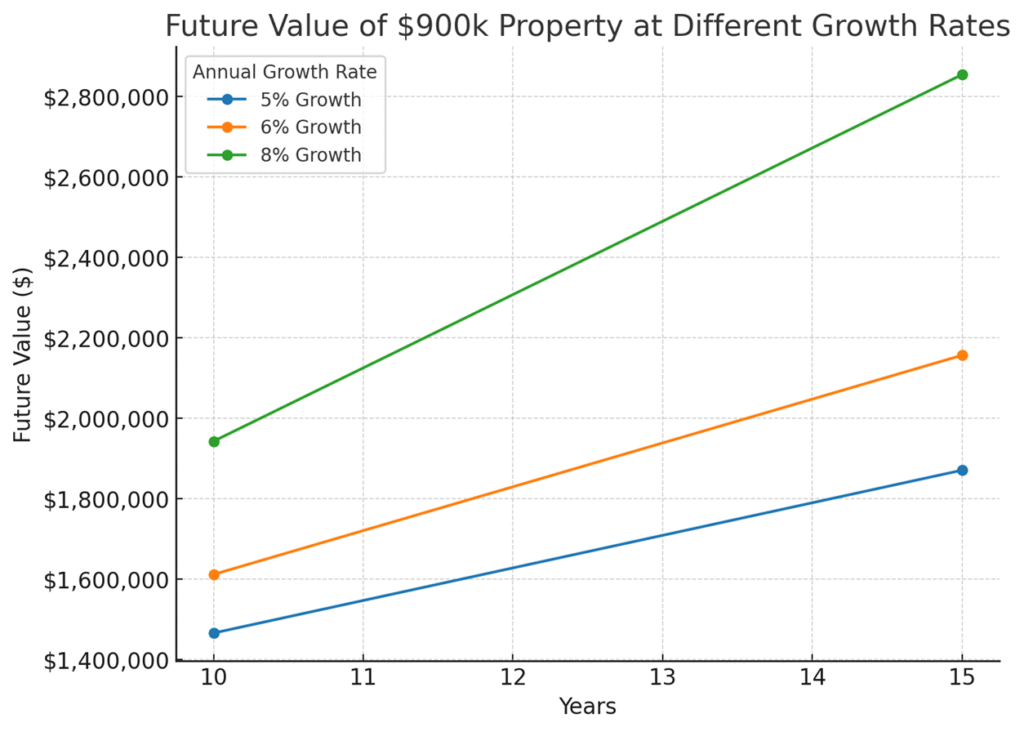
The numbers: a $900k example (if the forecast holds)
- Purchase price today: $900,000
- Assumed growth rate: 8% annually
- Over 15 years: ≈ $2.85 million
That’s almost $2 million in capital gain – on paper.
Even if growth tracked Auckland’s historic ~6.6% average, the figure would be closer to $2.4 million – still substantial.
Of course, numbers on a spreadsheet don’t tell the full story. If infrastructure is delayed, or if economic conditions weaken, actual outcomes could be much lower. Property values can and do move in cycles.
The risks every buyer should weigh
While Karaka–Drury has strong fundamentals, no forecast is risk-free. Consider:
- Economic cycles: High interest rates or weaker migration flows can stall demand.
- Delivery delays: Rail stations or motorway projects could take longer.
- Policy shifts: Zoning, intensification, or infrastructure funding may change.
- Market corrections: Property markets don’t rise in straight lines. There will be downturns along the way.
It’s vital to remember that property investment always carries risk, and short-term volatility is normal – even if the long-term outlook looks positive.
Why early buyers still take notice
Developments like Burberry Heights in Karaka–Drury are positioned to benefit if the forecast plays out. Early buyers are effectively backing the long-term transformation story – knowing that:
- The quietness today is temporary, with major projects already underway.
- Each milestone completed (rail stations opening, SH1 upgrades finishing, town-centre stages delivered) tends to boost confidence and reduce perceived risk.
- Buying early can mean securing property at today’s values, before infrastructure-led demand re-rates the area.
That said, the decision should be made on conservative assumptions. If the numbers work for you at 5 – 6% growth (Auckland’s long-term average), then any uplift to 8% is a bonus – not a promise.
Bottom line
The Karaka–Drury region has many of the hallmarks of a future growth hub: large-scale infrastructure investment, major housing delivery, and a planned town centre that could anchor tens of thousands of jobs and residents.
Forecasts of 8%+ annual growth are based on the region’s unique circumstances layered on top of Auckland’s long-run 5 – 6% growth average. If these forecasts play out, a $900k home today could be worth close to $2.85m in 15 years.
But nothing in property is certain. Delays, economic shocks, or policy changes can all alter outcomes. For buyers, the safest approach is to run your numbers on conservative assumptions – and view any upside as just that: potential upside.
In short: Karaka–Drury has the right ingredients, but investment here is about patience, timing, and a willingness to hold for the long term.
Disclaimer:
The 5 – 6% annual growth scenarios are based on Auckland’s historical long-term average property growth rates (source: Opes Partners).
The 8% scenario is a forward-looking forecast based on planned infrastructure and development in the Karaka–Drury region.
These figures are illustrative only. Actual property values can be higher or lower depending on economic conditions, project delivery, interest rates, and government policy. Property investment always carries risk, and past performance or forecasts do not guarantee future returns.